The Quality of Movement in TaiJiQuan
A Complete Guide to Whole-Body Coordination, Balance, Force, and Spirit
PART I
What Is “Quality of Movement” in TaiJiQuan?
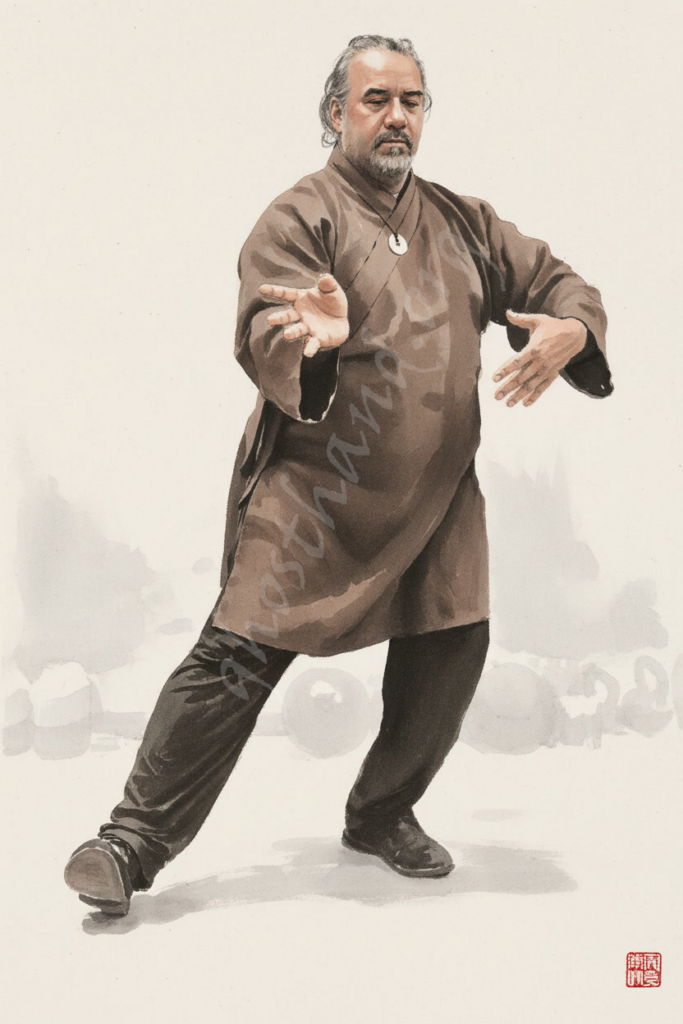
In TaiJiQuan, movement quality refers to how the body moves—not merely where it goes.
In TaiJiQuan, movement quality refers to how the body moves—not merely where it goes.
Two people may perform the same Tai Chi form, step through the same postures, and even look similar to an untrained eye. Yet one person is practicing choreography, while the other is practicing TaiJiQuan.
The difference lies in:
- Whole-body coordination
- Structural integrity
- Balance under motion and pressure
- The intelligent issuing and receiving of force
- The expression of calm, clarity, and spirit through movement
TaiJiQuan is not about isolated techniques or muscular strength. It is about teaching the entire body to move as one unified system, moment by moment, breath by breath.
This is why quality of movement is both the great challenge and the great reward of TaiJi practice.
The Difficulty of Whole-Body Coordination
Getting the entire body to coordinate appropriately—every time you move—is profoundly difficult.
Most people are accustomed to moving in pieces:
- Arms do one thing
- Legs do another
- The torso compensates afterward
- Balance is corrected late rather than maintained continuously
TaiJiQuan asks for something radically different.
Each movement must be:
- Initiated from the ground
- Supported by the legs
- Directed by the waist and spine
- Expressed through the arms and hands
Nothing moves independently. Nothing is accidental.
This level of integration does not come naturally, because modern life trains disintegration—sitting, isolating muscles, reacting rather than coordinating.
TaiJi retrains the nervous system to unify.