The Quality of Movement in TaiJiQuan
A Complete Guide to Whole-Body Coordination, Balance, Force, and Spirit
PART III
Balance: The Hidden Foundation
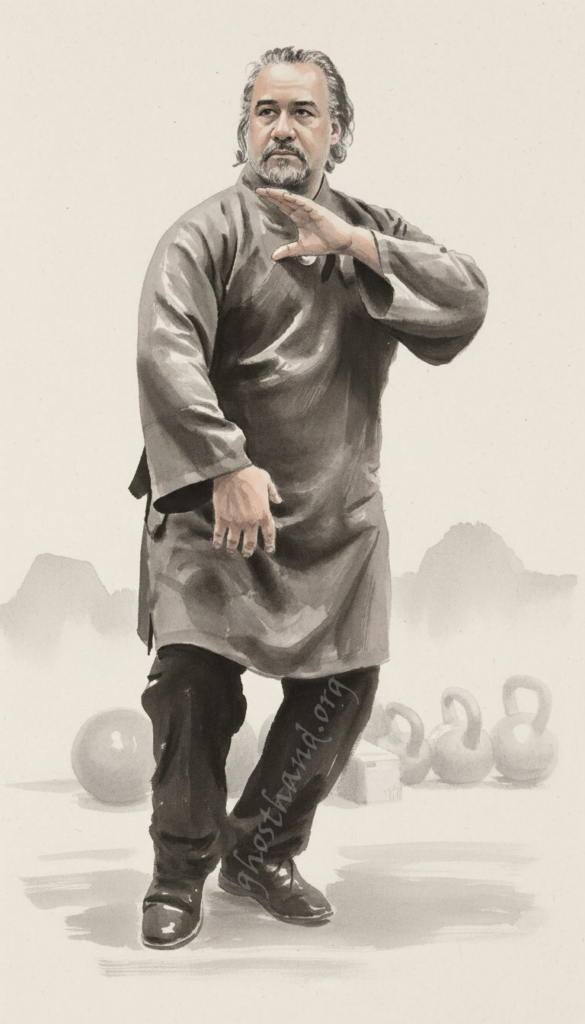
Before discussing force, speed, or application, TaiJiQuan demands mastery of balance.
Not static balance—but dynamic balance.
TaiJi stances and footwork:
- Load the legs asymmetrically
- Stress joints in unfamiliar ways
- Require constant micro-adjustments
Many positions feel awkward at first—not because they are wrong, but because they expose weaknesses in:
- Ankle mobility
- Knee alignment
- Hip stability
- Pelvic control
TaiJi does not avoid these weaknesses. It reveals them, then slowly resolves them through intelligent practice.
True balance in TaiJiQuan means:
- You can move without losing structure
- You can pause at any moment
- You can accept force without stiffening
This balance is earned, not assumed.
Accepting Another Person’s Weight and Force
When partner work enters the picture, the difficulty increases dramatically.
Accepting another person’s weight or force requires:
- Structural alignment under pressure
- Relaxation without collapse
- Awareness without anticipation
If your balance is incomplete, force will uproot you.
If your structure is rigid, force will shatter it.
TaiJiQuan teaches the practitioner to:
- Receive force into the ground
- Neutralize without resistance
- Maintain balance even while yielding
This is where TaiJi stops being theory and becomes embodied truth.
Final Thoughts: Mind-Body-Spirit Integration
You deserve to feel safe, capable, and alive in your own skin, and at peace in your own mind. Self-defense training teaches you how to protect yourself, while martial arts cultivates focus, strength, and peace of mind. Together, they give you a mind-body-spirit connection that radiates into every corner of life. If you’re in Pittsburgh and ready to claim that power for yourself, come train with us — and see how quickly your world begins to change.