Practice Eye: A Dialogue on Entering the Dharma
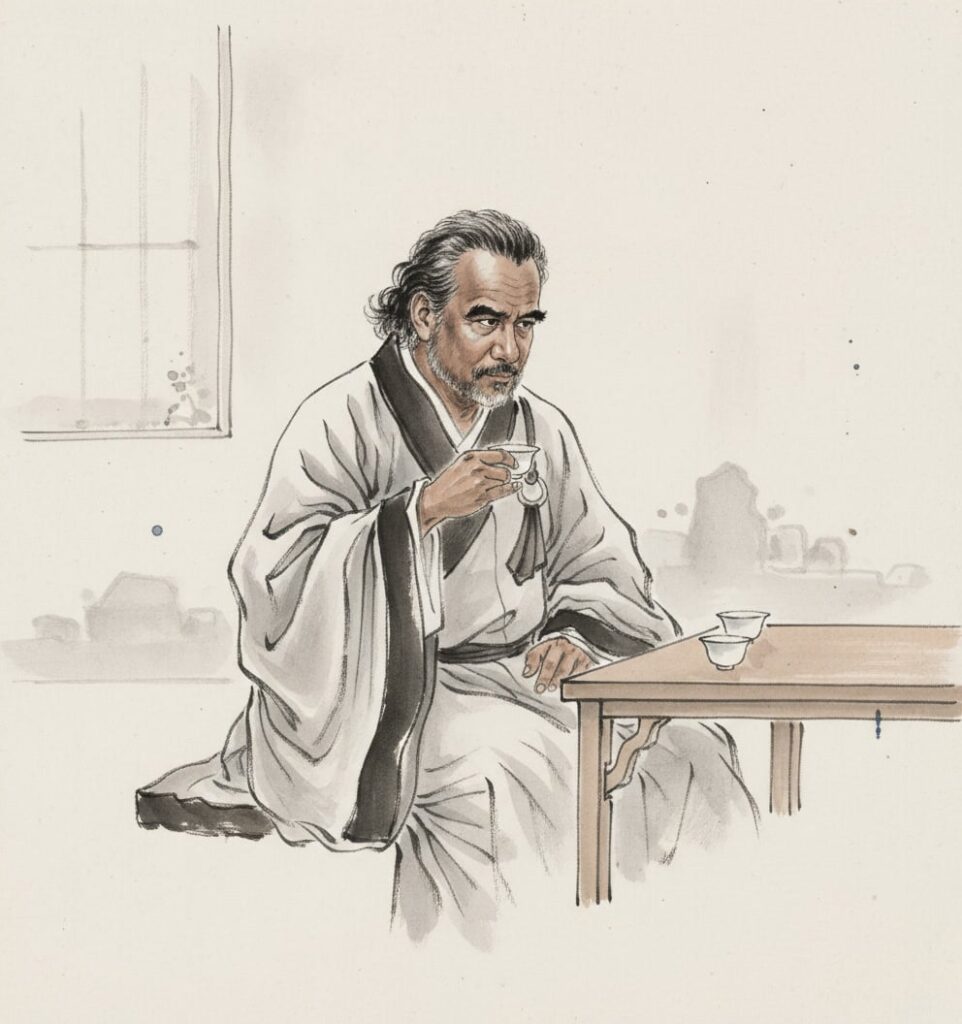
A conversation between
You Daozhe and a student,
on the occasion
of a friend receiving
her Dharma name.
Many beginners think that knowing something, even understanding something, means they’ve accomplished a goal.
This is not the same as the 'enlightenment' that comes from truly living one's practice.
In this dialogue between teacher and student, discover why the preconditioned mind is not the enemy — recognizing it's ego-based state of being, and making the decision to continuously study and find the true nature of one's self in relation to that state, is the lesson.
Student: A friend of mine officially entered her Zen sangha. She was given her “Buddhist” name. Is that a thing?
YouDaozhe: Yes—very much a thing. And “Buddhist name” is a perfectly understandable way to describe it, though different traditions use more specific terms.
In many Buddhist traditions, when someone formally takes refuge, receives the precepts, or becomes an acknowledged member of a lineage, a teacher gives them a Dharma name. In Japanese Zen, this is commonly called a hōmyō (法名), literally “Dharma name.” Depending on the school and ceremony, you may also hear kaimyō (戒名), “precept name.”
The name isn’t chosen like a nickname. The teacher selects it intentionally, often using one or more Chinese characters whose meanings reflect something the teacher perceives in the student—their character, aspiration, practice, potential, or sometimes even the particular obstacle they’re being encouraged to work through.
So if your friend “officially entered her Zen sangha” and was given a new name as part of that ceremony, that sounds entirely normal.
And here’s a wrinkle you might appreciate: the name isn’t necessarily a compliment. A teacher can give someone a name that points toward a quality they need to cultivate rather than one they’ve already mastered. In that sense, it can function almost like a practice instruction disguised as an identity.
If you can find out the name she was given—ideally the Japanese spelling or kanji—I can unpack what it means and what her teacher may have been pointing toward.
Student: She was told it means, verbatim, “practice eye.” She hates it, and I know that every time something looks one way you always find different ways for me to see it, so I guess I’m asking you what I can tell her to – I guess you’d say ‘disconnect’ from the words themselves, and look at the feelings, the reactions, for answers instead?
You Daozhe sips and with eyes narrowing into smiles nods his head. The student smiles in self-approval, and those smiling eyes become a little more stern and seem to say
“Don’t get cocky, kid.” Placing his cup silently upon the stone table, he continues as if nothing happened –
YouDaozhe: Ohhh. “Practice Eye.” That is considerably more interesting than it sounds in plain English.
If that’s a verbatim rendering, I’d want to see the actual kanji before claiming exactly what her teacher intended—several Japanese characters can be translated as “practice” and several as “eye,” and Buddhist compounds often carry meaning beyond their dictionary definitions.
But conceptually, “eye” carries enormous significance in Zen. It frequently means the capacity to see clearly—not ordinary visual sight, but discernment, insight, seeing reality directly, recognizing the Dharma. Zen literature is full of expressions like the “Dharma eye,” the “true eye,” the “eye of wisdom.”
And “practice” in Zen isn’t merely rehearsing a technique until you’re good at it. Depending on the character, it can mean disciplined cultivation—the lived embodiment of the Way itself.
So “Practice Eye” could carry a rather beautiful double implication: the eye that is cultivated through practice, and the capacity to see practice itself clearly.
There’s another reading I particularly like, though I wouldn’t attribute it to her teacher without seeing the characters: learning to see everything as practice. Washing dishes is practice. Irritation is practice. Work is practice. The difficult person is practice. Sitting is practice. Getting up from sitting is practice. That would make “Practice Eye” less like “one who practices seeing” and more like—one who develops the eye that recognizes the opportunity for practice in everything.
If you can get me a photo of the calligraphy she received—or just the two characters themselves—I can tell you far more precisely what the name actually says, including the shades of meaning that get lost when someone simply translates it as “Practice Eye.”
[The student sends a photograph.]
YouDaozhe: Ah—this is the inside of a rakusu. That changes things, and it’s worth pausing on before we get to the characters.
A rakusu (絡子) is the small, bib-like patchwork garment worn around the neck and hanging over the chest in Japanese Zen. It represents, in miniature, the kāṣāya—the patched robe traditionally worn by Buddhist monks. There’s quite a bit packed into that little piece of cloth.
Traditionally, the Buddha’s robe was constructed from pieces of discarded cloth sewn together. That patchwork pattern came to symbolize renunciation, simplicity, and the Buddhist path. The rakusu preserves that symbolism in a garment small enough to wear over ordinary clothing.
In many Japanese-derived Zen communities, a lay practitioner receives a rakusu when undertaking Jukai—formally taking refuge in the Three Treasures and receiving the precepts. That’s very much the ceremony you described when you said your friend “officially entered” her sangha.
This is also why your photograph matters so much: the inside of a rakusu is often inscribed by the teacher. It can carry the practitioner’s Dharma name, the teacher’s name and seal, the date of receiving the precepts, and traditional inscriptions. So what you photographed is both a garment and a record of transmission—a document of commitment stitched into cloth. When she wears it, she is symbolically putting on the Buddha’s robe and taking up the precepts.
There’s a lovely sewing tradition tied to this, too. In some lineages, the student sews their own rakusu, stitch by stitch, as preparation for receiving the precepts. The construction itself becomes practice, before the practice even formally begins.
Now—the name.
The characters written on the rakusu are:
参眼 — SAN GEN
And the teacher has actually annotated them in English right beside the kanji:
- 参 (SAN) — “Practice”
- 眼 (GEN) — “Eye”
So she wasn’t given a loose interpretation. “Practice Eye” really is the intended literal rendering.
What makes it richer is the first character, 参. It carries senses of participating, entering, attending, engaging, taking part. In Zen vocabulary it has a particularly strong association with engaging in Zen practice itself—as in sanzen (参禅), literally “engaging in Zen.”
And 眼 (gen) is literally “eye,” but Buddhist and Zen usage extends “eye” to mean the faculty of insight—discernment, seeing into the nature of things.
So 参眼 / Sangen has a wonderful tension built into it. The literal English is indeed:
PRACTICE EYE
But I wouldn’t hear that as merely “an eye that practices.” Something closer to its Zen resonance would be:
- The eye developed through practice.
- The capacity to see through practice.
- Seeing with the eye of one who truly enters the practice.
Which makes something I said before I ever saw the characters rather gratifying: the guess that it could imply learning to see everything as practice wasn’t far afield at all. The actual character 参—to enter, to engage, to participate—makes that reading especially apt.
And frankly, Practice Eye is a formidable Zen name. It doesn’t describe an accomplishment. It describes a lifelong instruction: practice, and learn how to see.
One last thing worth sitting with. This name is stitched inside the rakusu—not embroidered on the front, not announced anywhere visible. When she wears it, no one else needs to see the name. She knows it’s there. It isn’t a badge announcing who she is. It’s a reminder of what she has undertaken to practice.
Key Insight — The Difference Between “Doing” and “Being”
Meditation begins when effort relaxes into awareness.
The mind will wander. That’s its nature.
Your task isn’t to cage it, but to witness its flight.
Takeaway Practice:
Sit for five minutes.
Breathe naturally.
Each time you notice a thought, whisper “thinking” and return to the breath.
Celebrate every return — it’s proof you’re conscious.