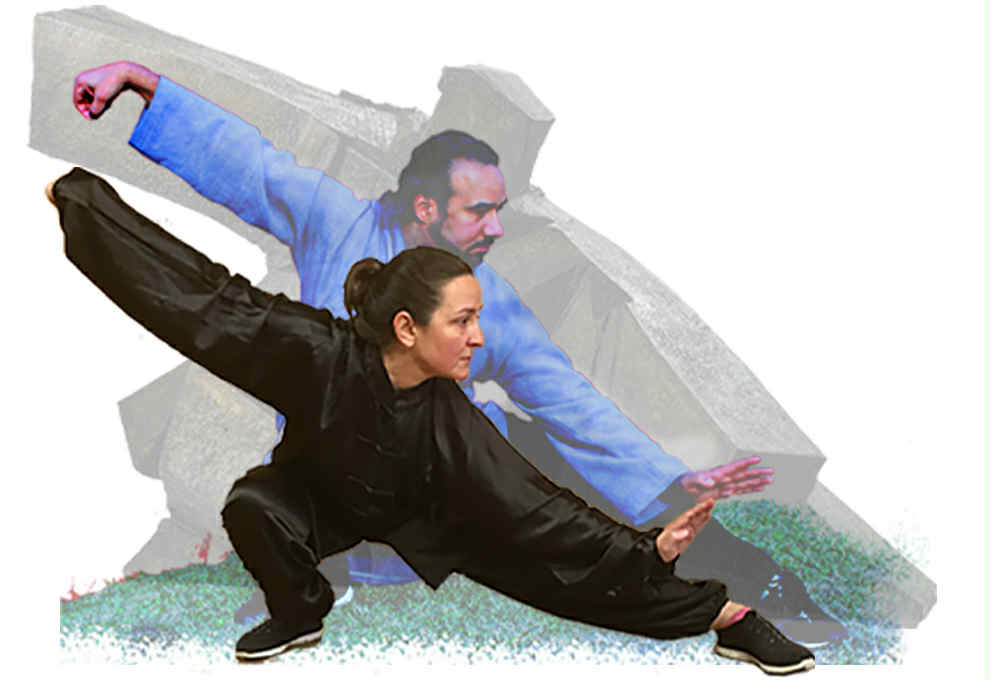
I am writing this as a result of 2 things: I’d recently read someone else’s article which spoke word for word what’s in my heart about the current state of TaiJi these days, and 2, I met a true charlatan of martial arts pretending to be a BaGua (of ALLLllllllll the arts to pretend to know-!!!!) instructor. His whole schpiel is “join my YouTube (I wanna get paid!)”, and “once you see my videos, when you see how well I move”. Well. When questioned, he ultimately admitted that everything he (ahem) ‘learned’ was from BOOKS, and that he’s never actually had a physical instructor in the real world. And no, he doesn’t spar, nor do rou shou or tui shou (push hands exercises) because “they just program you to do the wrong things”. You know where I’m going with all of this.
It isn’t the greed and avarice of people trying to make a name for themselves and increase their wealth that I find so bad. It’s that these charlatans are willing to let good and decent people waste years of their life, and who knows how much money, in pursuit of what these frauds know are nothing but lies.
It’s despicable.
So, this having all been said, let’s talk about authenticity. There are enough written sources in books and on the web for people (I’m assuming that that’s why you’re even reading this) to educate themselves about all of the lore, the fantasy, the history, etc. What I want to do is just narrow it down and home in on just one point: EFFECTIVENESS. Regardless of what the frauds and get rich quick/community college TaiJi ‘teachers’ have done to reduce and dilute this fantastic jewel of Chinese Physical Cultue in the recent decades, TaiJi was designed and practiced as a full-fledged Traditional Chinese Martial Art. I’d like to make my case for why you should absolutely challenge (politely) your teacher any time something doesn’t make sense. I allow my students to question every single thing. And here’s why….
When most people picture the ideal Taijiquan teacher, they imagine someone warm, inspiring, and endlessly supportive. But personality has little to do with whether you truly learn the art in its authentic form. A genuine teacher is not defined by charm or storytelling, but by whether they carry and transmit a real tradition—an unbroken chain of method and principle that produces the abilities Taijiquan is meant to develop. – personality doesn’t make you skilled. Charm doesn’t give you root. Smiles don’t issue force. My TaiJiQuan teacher, DaShiFu Anton Haddad, looked like some mean biker-dude, but sounded like a ‘valley girl’ when he spoke! For him, because the Northern Shaolin system that he taught was his family’s system, TaiJi kinda took a back seat. His senior student (at the time) spoke with great eloquence (he was a part-time actor), was doing private studies with LuPing Zhang, a Chinese national that had international recognition. Tony (Anton) was this laid back punk/hippie who spoke very casually about TaiJi, whereas his senior student, Larry Tolbert, was pompous and kinda required that you look upon him with a kind of reverence because he was studying with this other guy (for over a decade before I came along). The two were diametrically opposed. I felt like Mr. Tolbert became managable after just a year of practice with Tony. Yet when I touched hands with Tony, his structure, rooting, and ability to issue and neutralize force were – catastrophic, to put it mildly. On the other hand, I’ve met teachers whose charisma could command a room, spin elegant and beautiful stories of ancient masters, and inspire applause and admiration—yet when tested, their skills vanished into empty choreography.
Authenticity in Taijiquan means the method aligns with the art’s core principles, and the results can be demonstrated and felt—not just talked about. In other words, it’s about whether the method works. As a student, your personal assessment must come from experience: pushing hands with different practitioners, feeling how they move, and testing whether their claims hold up under pressure. What matters is whether a teacher carries the real art—a living method, passed down intact, that actually produces the skills Taijiquan promises. Structure. Root. The ability to neutralize and issue power. Can it be demonstrated? Can you feel it? Can it stand up to pressure? Those answers come only from direct experience: pushing hands, testing structure, finding out for yourself. Certificates, photos, and grand titles prove nothing. If that’s not there, everything else is window dressing. Stories, certificates, and photos are easy to obtain; real skill is not.
The hard truth is that no one can give you the art with words alone: no one can talk this art into you. A teacher can point the way, open the door and correct your course, but understanding only comes from your own sweat, mistakes, and perseverance; only these things will walk you through the door. You don’t know Ward Off energy because it was described beautifully; you know it when you can express it in real time against real force.
And beware: personality is a trap. Charm can blind you to a lack of depth, while harshness can make you overlook genuine skill. Many walk away from harsh but skilled teachers who hold the keys they’re searching for, while flocking to friendly frauds who leave them unskilled but entertained. Many students leave strict but skilled teachers in favor of pleasant frauds who entertain but never develop them. My own progress accelerated when I stopped expecting emotional support from teachers and began seeing them simply as guardians of the method. And, most importantly, when I held myself to those self-same standards and found myself a gatekeeper of authenticity as well.
In traditional Taijiquan, the relationship isn’t based on Western-style friendship but on mutual responsibility: the teacher preserves the art’s integrity, and the student trains until the art lives in their body. The teacher is the doorway—whether they smile or scowl as you walk through it doesn’t matter. What matters is whether the path beyond that door is real, and the only way to know is to walk it yourself, step by step.
TAIJI CLASSES TAUGHT BY MASTER MARC PHILLIP BLACK